


Written by Andi (Amanda) Williams, Principal Psychologist. Known for Keeping the Socratic Method Alive. Known for analogies or ‘Andi-ologies’.
This article was written by the author without AI; it’s a natural product made from recycled electrons, and any errors in tact, or fact, are transmission errors made by the electrons.
TLDR: The best analogy I’ve ever heard, is that resilience is like bouncing a ball on concrete and it coming straight back to where it started. Most ‘resilience’ ideas are based on improving ‘ball smoothness’ (individuals) rather than the surface it bounces on (environment). The reality is, no ball is coming back if you throw it in a swamp. More resilient people don’t change as quickly/obviously as their environment changes, but sensitive people do. Sensitive people are the ‘canaries in the coalmine’ and if you lose them, your most important ‘early warning system’ is missing.
I can’t ever recall telling a client, ‘let’s build your resilience it will fix everything’; but I see that advice everywhere, especially on social media.
‘Resilience in the workplace’, ‘how to build a resilient workforce’, ‘how to become more resilient’, ‘building resilience tips and tricks’…
Is any of the advice actually helpful? Is any of it actually going to improve your ‘resilience’ or your life? Maybe. From what I’ve seen, this is mostly because the advice isn’t about resilience at all, but about developing healthy and productive coping strategies. Coping strategies are a great way to maintain or generate good mental health, so go for it! It’s just not actually technically what resilience is.
What is missing from most advice is evidence; references or scientifically validated sources or experts that can demonstrate how this advice translates to real positive outcomes for individuals. For someone with a scientific background, this absence can be incredibly frustrating.
It’s frustrating for others as well, based on questions I’ve been asked: ‘which advice do I take?’ ‘I did everything they said, why aren’t I doing better?’ ‘Is there a Return On Investment (ROI)?’ ‘What happens if I take the wrong advice?’
© Copyright Everyone Psychology. All Rights Reserved. Do Not Publish or Reprint without Permission. © Everyone Psychology, Online Psychologists Telehealth Counselling and Coaching Australia .
What is ‘resilience’, really?
Resilience is the capacity of a material or system to take a hit and just keep going as before. The best analogy I’ve ever heard, is that resilience is like bouncing a ball on concrete and it coming straight back up to where it started.
The concept of psychological (individual) resilience is based on evolutionary and developmental psychology. Instead of a history lesson, when I discuss this idea over coffee I usually draw on a napkin the two main figures found in research.
Figure 2 the diathesis-stress model
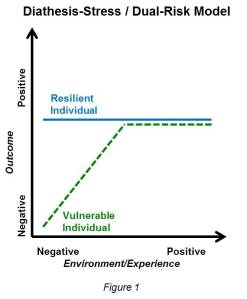
When you consider everything you’ve heard about resilience, you’ll recognise Figure 1, technical term: the diathesis-stress model.
This (Figure 1) is what most of the internet/social wisdom tells you resilience is: resilient people have better outcomes all the time, because resilient individuals seem to maintain the same outcome regardless of environment.
If this is accurate (spoiler alert: it’s not) , ‘environments’ are child-rearing practices or traumatic events, or in a workplace, the ‘company culture’. Environments can be considered as ‘toxic’ (negative) or ‘enriched’ (positive). Note that these people show consistent performance, not ‘high’ performance, but without the ‘low’ performance in toxic environments that non-resilient individuals show, they appear to be ‘minimal risk’ employees and ‘stable’ persons.
As some recruitment experts will tell you, recruitment is about minimising business risk. Accordingly, most of the business advice is focussed on selecting, retaining, and even training for ‘increased resilience’. Most of the individual advice is about ‘increasing your personal resilience’ for ‘wellness’.
Referring back to that ball analogy, this concept places all the attention on the material the ball is made of, and suggests that some balls bounce back perfectly on every surface.
If non-resilient individuals experience negative outcomes in toxic environments at work (e.g. reduced general performance/KPIs, poor team interactions, absenteeism, presenteeism, increased sick leave) then the ‘business case’ and ROI for ‘training for resilience’ is self-evident. From a more personal perspective, who doesn’t want to be sick less often and have better performance reviews?
Referring back to that ball analogy, this is now placing all the attention on smoothing out the outer surface of a ball, so that it bounces back perfectly on every surface.
© Copyright Everyone Psychology. All Rights Reserved. Do Not Publish or Reprint without Permission. © Everyone Psychology, Online Psychologists Telehealth Counselling and Coaching Australia .
What if this is wrong?
Figure 1 scientifically competes with Figure 2, the differential susceptibility model proposed by Belsky over a decade ago. In fact, evidence from genetic markers better support the differential susceptibility model, compared to the diathesis-stress model. Scientists are always careful with the word ‘certainty’, but this is considered the preeminent theory in our current understanding of resilience as a psychological construct. Translation: the differential susceptibility model is how resilience actually works (and we’re as ‘certain’ about this theory, as we are ‘certain’ about the theory of gravity).
© Copyright Everyone Psychology. All Rights Reserved. Do Not Publish or Reprint without Permission. © Everyone Psychology, Online Psychologists Telehealth Counselling and Coaching Australia .
Figure 2 the differential susceptibility model
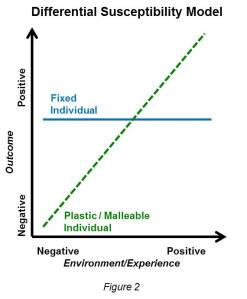
Experts describe the Figure 2 model as biological sensitivity to context. Rather than describing people as non-resilient vs. resilient, consider them as ‘sensitive’ (plastic) or ‘unaffected’ (fixed).
© Copyright Everyone Psychology. All Rights Reserved. Do Not Publish or Reprint without Permission. © Everyone Psychology, Online Psychologists Telehealth Counselling and Coaching Australia .
This means that more sensitive (non-resilient) individuals, are still likely to be poor performers in toxic environments, but they will outperform unaffected (resilient) others in enriched environments.
Remember: resilience is the capacity of a material, system, or individual to take a hit and just keep going as before. Being able to adapt to new circumstances and take small hits is healthy, appropriate, and necessary. The problem is: if someone staggers due to a hit they just took, and we tell them they need more resilience, we completely skip over understanding how big a hit they actually took. Not all adverse situations should be ‘adapted’ to: we wouldn’t expect people to ‘adapt’ to slavery, discrimination, or corruption.
Referring back to that ball analogy, this idea acknowledges that you can throw balls at a swamp, but no ball is ever bouncing back. Some environments just don’t support balls bouncing, no matter how bouncy the individual ball is. 🤷♀️
© Copyright Everyone Psychology. All Rights Reserved. Do Not Publish or Reprint without Permission. © Everyone Psychology, Online Psychologists Telehealth Counselling and Coaching Australia .
What does this mean?
If a company has only ‘resilient’ employees, executives can be completely unaware whether the culture is enriching or toxic. Traditional markers of toxic cultures are masked: voluntary employee turnover or absenteeism may be less obvious, because resilient individuals have the psychological capacity to ‘bide their time’ in a negative environment and choose when to leave.
No one will stay in a toxic culture forever, but unaffected/resilient individuals will last longer, be less affected by poor management practices, and generally be still able to get some work done.
I can hear some executives saying, “But, consistent performers are exactly what we want!”
Let’s gently challenge (like Socrates!) that thought by asking, “ok, but what are you losing?” 💭
Since unaffected individuals can ‘mask’ the effect of a toxic culture, the people being lost are the ‘canaries in the coalmine’. Sensitive individuals are more aware of toxic cultures, because they feel the effects of them more strongly.
© Copyright Everyone Psychology. All Rights Reserved. Do Not Publish or Reprint without Permission. © Everyone Psychology, Online Psychologists Telehealth Counselling and Coaching Australia .
Sensitive individuals will notice, and (if you’re lucky) even openly ask questions about: unethical practices, poor team communication, health hazards, poor management, costly policies, or short-sighted ‘cost-cutting’ measures.
Referring back to that ball analogy, the point here is that if you have really resilient balls that bounce well, you won’t notice when the surface is turning from concrete, into a swamp, until it’s far too late.
Sensitive employees are like a ‘bellwether’, they will gravitate toward enriching cultures, and they can warn you the ship is sinking probably before executives see water on board. (Remember, more valid and helpful information is provided confidentially over the phone than through an anonymous survey during ‘exit interviews’.)
© Copyright Everyone Psychology. All Rights Reserved. Do Not Publish or Reprint without Permission. © Everyone Psychology, Online Psychologists Telehealth Counselling and Coaching Australia .
If you struggle under certain managers in the workplace, but not others: you might be a resilience ‘canary’.
Sensitive individuals are more likely to leave toxic cultures, and they are likely to leave sooner.
Hiring managers: Maybe it’s time to question whether the team is screening out poor performers, or scaring away your ‘canaries’. Maybe it’s time to question whether a potential candidate is ‘job hopping’ or is just actively seeking the most enriching (non-swamp like) environment.
Researchers can consistently demonstrate that high-performing teams will choose to fire or replace the ‘devil’s advocate’ – even if this person was chosen at random, and everyone knows it was random! Fact: having the randomly chosen devil’s advocate was WHY the team had superior performance in the first place! So, we know empirically (thanks science!) that our personal discomfort to having our ideas openly challenged or critically evaluated (ouch), even if we know exactly what the person is doing and we know that they are helping us, results in social exclusion. Just ask Socrates…
© Copyright Everyone Psychology. All Rights Reserved. Do Not Publish or Reprint without Permission. © Everyone Psychology, Online Psychologists Telehealth Counselling and Coaching Australia .
What is the worst case scenario?
Well, how toxic does a culture become before someone risks their livelihood to speak out?
Companies with toxic environments invariably end up publicly shamed or bankrupt or ethics case studies or legal precedents. Who were the ‘canaries’ at these infamous places?
Once when I drew this idea on a napkin, my colleague asked me a question I hadn’t realised also needed answering: “what kind of person does well in a toxic environment?” Answer: exactly the type of person you’d think.
We know empirically (thanks again science!) that certain kinds of ruthless individuals succeed in the business world. The dark triad of anti social personalities and behaviours: narcissism, Machiavellian and ‘psychopaths’. In a toxic workplace culture, it is easy to see how a ruthless individual would be able to perform well, and even ’rise through the ranks’, without any ‘canaries’ to raise the alarm.
© Copyright Everyone Psychology. All Rights Reserved. Do Not Publish or Reprint without Permission. © Everyone Psychology, Online Psychologists Telehealth Counselling and Coaching Australia .
How to be part of the solution?
If you work or teach in this space, please stop using resilience as the ‘magic pill’ when people feel stressed or overworked or otherwise unfulfilled (especially at work). Resilience is simply a word to describe how sensitive vs. unaffected an individual is within different environments. If you need your employees to be super resilient, you may be missing psycho-social hazards, and those risks come with serious legal obligations.
Be wary of those who choose to select/retain/train for resilience. Sensitive people are your ‘canaries’, if you don’t have any, you won’t know what kind of workplace environment you are fostering. The impact of unethical or toxic business practices can be lethal for a company. The quality of a company is only as good as its people – those people will tell you when things aren’t right, we just need the humility to listen. Let’s move past resilience as a ‘buzz word’ and create real outcomes.
© Copyright Everyone Psychology. All Rights Reserved. Do Not Publish or Reprint without Permission. © Everyone Psychology, Online Psychologists Telehealth Counselling and Coaching Australia .
Last thought: can we change our biological sensitivity to context?
Like me, you may see a similarity between these ideas and those of Dweck’s Fixed vs Growth mindsets for learning. The need to survive (temporarily) in a toxic environment for a while happens to us all, and the ability to recover faster from being in a toxic environment is also appealing. Remember, humans can’t survive in toxicity for long, and glorifying surviving a toxic work environment is not healthy. There is some evidence we can reduce the emotional distress that may come with sensitivity through adaptive coping strategies. Ask a professional for guidance on how to achieve this if unsure.
Fair warning: Inspirational quotes, colouring books and yoga classes aren’t ‘magic pills’ that increase your ability to handle a toxic environment. In fact, these ideas might make things worse – so please talk to a professional. That said, if you want to handle situations better, I do recommend that you try something because I believe that ‘if you change nothing, nothing changes’. It’s ok to try things and realise they didn’t work, just get started 😁.
© Copyright Everyone Psychology. All Rights Reserved. Do Not Publish or Reprint without Permission. © Everyone Psychology, Online Psychologists Telehealth Counselling and Coaching Australia .
The first draft of this article was published on LinkedIn on 16 April, 2018
© Copyright Everyone Psychology. All Rights Reserved. Do Not Publish or Reprint without Permission. © Everyone Psychology, Online Psychologists Telehealth Counselling and Coaching Australia .
If you are starting to experience difficulties at work or at home, waiting until things get worse can cost you more than money. Help is available, and you definitely aren’t alone (even if it feels that way). 💚💛 Please talk to someone, like a free crisis service. If you want to talk to Andi, book online now or contact us.
Find a psychologist to get help with Life Coach | Stress | Anxiety | Depression | EAP | Sleep | Resume and Interview skills | Career coach | Executive and Entrepreneur coach | WorkCover WorkSafe RTW | WH&S | NDIS | Couples ENM Family counselling | Parenting coach | Trauma Recovery and PTSD | DV/FV/CC Recovery | Pregnancy counselling | Forced Adoption counselling | Post-partum Depression and Anxiety | Chronic Illness | Palliative Care | Grief | Allied Health coaching | Psychologist Case Conferencing and Peer Consultation with Everyone Psychology.
 Everyone Psychology
Leave a comment