

You don’t need a GP referral to see a psychologist, you only need it if you want Medicare rebates. Other rebate options for health services are: WorkSafe/Workcover, TAC, your employer (EAP), private health insurance (e.g. Medibank, Bupa, HBF, etc).
If you would prefer to stay anonymous or use a pseudonym, you will be ineligible to access rebates or tax deductions.
If you are accessing our coaching and business (non-health) services, you can retain your invoice and ask your accountant about claiming ‘self paced’ ‘self-education’ expenses for Australian tax deductions.
A guide to Medicare rebates
To keep it simple, to process your Medicare rebate we ask for both referral + MHTP. We’re aware the Medicare system is very (and we would argue, unnecessarily) complicated. Please write to Medicare or your political representative on this issue. 😀
DISCLAIMER: We’ve done our best to provide accurate information here, but we are NOT Medicare and this is a guide only. If you find an error, we welcome your feedback. Everyone Psychology has prepared this page in good faith efforts to assist you but Everyone Psychology and it’s staff are not liable for errors or omissions in this guide.
You receive Medicare rebated sessions under a Mental Health Treatment Plan (MHTP) with a referral. The referral doesn’t expire, but you are limited to 10 rebates per calendar (1 Jan-31 Dec) year. Gap fees are also reduced by the Medicare safety net, and you can apply as a family (shared expenses).
You don’t need a new MHTP each year, but need a new referral every 6 sessions.
Medicare doesn’t ‘back date’ referrals. In other words, if you have a referral dated the 4th, Medicare will rebate a session on or after the 4th. Medicare won’t rebate for a session on the 4th, for a referral dated the 5th.
What’s the difference?
A good analogy is that an MHTP is like a recipe for a meal for someone with some dietary specific needs or allergies, and the referral is the reservation at a particular restaurant. The restaurant (psychologist) needs to know the specific needs for that person (MHTP), but the restaurant can’t serve you a meal until after you make your reservation (referral) and you need to place your order (payment and rebate).
© Copyright Everyone Psychology. All Rights Reserved. Do Not Publish or Reprint without Permission. © Everyone Psychology, Online Psychologists Telehealth Counselling and Coaching Australia .
What do i do?
This 10 step guide allows us to arrange your Medicare rebate for you (if you process your own rebate, skip steps 5 & 6.)
- Go to your GP or psychiatrist and ask for a Mental Health Treatment Plan (MHTP) with a valid referral (example below).
- (optional) set up a Halaxy profile when booking to easily reschedule your sessions, and to get session reminders in your local time (default reminders are in AEST).
- Book a session online via Halaxy – email us or call us for help.
- If this is your initial (first) session, you’ll need to open a second automated email and take 5 minutes to complete online consent and intake forms – have your Medicare card ready! When prompted, fill in details and upload the files/papers (referral and MHTP) from Step 1. If this doesn’t work, email us a copy, OR have your Medical Centre to email us directly and please ask that they ‘CC:’ to your email as well. To check your rebate eligibility, we need your MHTP and referral at least 3 working days in advance. You can still have a session without them, but you may not receive a rebate.
- If you are requesting financial hardship reduced-fee sessions, you need to book a ‘standard consultation’.*
- You’ll receive an automated ‘booking confirmation’ email any time you successfully reserve a session. The email includes a ‘one-click’ button to reschedule or cancel your session. If this link doesn’t work, late cancellation fees may apply – read about our cancellation policies here.
- If this is your initial (first) session with us, you’ll get another email a few days before your session with the invoice for your session. If you have requested a financial hardship reduced-fee session, you will be able to check/confirm the lowered fee rate after booking under a ‘standard consultation’*. Please check the details of your Medicare card, referral, etc. Initial session fees are auto scheduled using your nominated payment method around 24 hours before your session time (up to 72 hours before is also possible). Pre-payment of initial sessions is required, to help identify any errors, such as incorrectly entered card numbers. Subsequent fees are deducted at the time of your future sessions.
- Attend your first session – it’s all downhill from here! We may ask you to clarify some details from your MHTP or referral. Ask any questions that you have, and discuss expectations and goals of your sessions with your psychologist.
- Attend five more sessions – and do your therapy homework 😉. After 6 sessions, we’ll write to your GP requesting another 6 session referral (please give us up to 14 days to write this).
- Repeat steps 1-9 as needed! (Remember, Medicare rebates are restricted to 10 per calendar year)
*’Standard consultation’ times do not include after hours or weekends. For hardship reduced-fee sessions, you need to provide a Healthcare Concession Card (HCC) or similar, or be willing to briefly explain your circumstances. Read more about our fees and cancellation policies here.
© Copyright Everyone Psychology. All Rights Reserved. Do Not Publish or Reprint without Permission. © Everyone Psychology, Online Psychologists Telehealth Counselling and Coaching Australia .
What is included in a valid referral?
An MHTP is NOT a referral, but an MHTP that includes all of the required referral information may be considered acceptable by Medicare.
If you do NOT have a valid referral, you can be required to pay back to Medicare all Medicare funded services during a Medicare audit. It is Medicare fraud for us to process a rebate on your behalf without a valid referral.
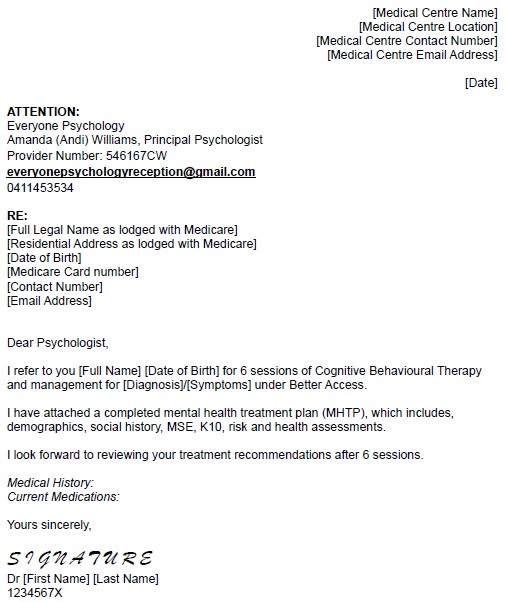
A valid referral includes ALL of the following information:
- date of referral
- referring doctor’s signature (this must be penned, or follow specific rules for electronic signatures)
- referring doctor’s Medicare Provider Number
- Your date of birth
- Your full legal name (as lodged with Medicare)
- Your address (as lodged with Medicare)
- Your Medicare card number
- a diagnosis OR symptoms
- list of current medications
- (optional) your medical history/diagnosis history
- a statement about whether you have a MHTP OR a psychiatrist assessment and management plan OR a specific request for psychological services ( e.g. ‘CBT’, ‘coping skills’, ‘anxiety management’ etc) AND/OR specify that services are to be provided by a psychologist AND request services under Better Access
- the number of sessions for this course of treatment
- contact information of the referrer (email address preferred)
- a copy of the MHTP attached to the referral (if the referral is missing information, the referral + the MHTP together can be considered valid)
Note: it does NOT matter who the referral is addressed to. If you attend 1-2 sessions with a psychologist, and then want to find someone who is a better fit, you do NOT need to get a new referral – just make sure that you tell us that you have only 4 sessions left (used 2 of 6) on your MHTP, so we can write back to your GP after 6.
© Copyright Everyone Psychology. All Rights Reserved. Do Not Publish or Reprint without Permission. © Everyone Psychology, Online Psychologists Telehealth Counselling and Coaching Australia .
Here is an example of a valid referral:
© Copyright Everyone Psychology. All Rights Reserved. Do Not Publish or Reprint without Permission. © Everyone Psychology, Online Psychologists Telehealth Counselling and Coaching Australia .
what is an mhtp?
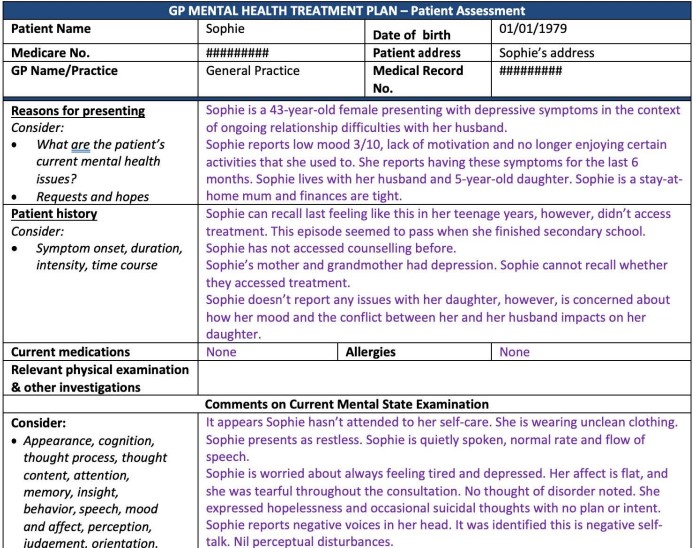
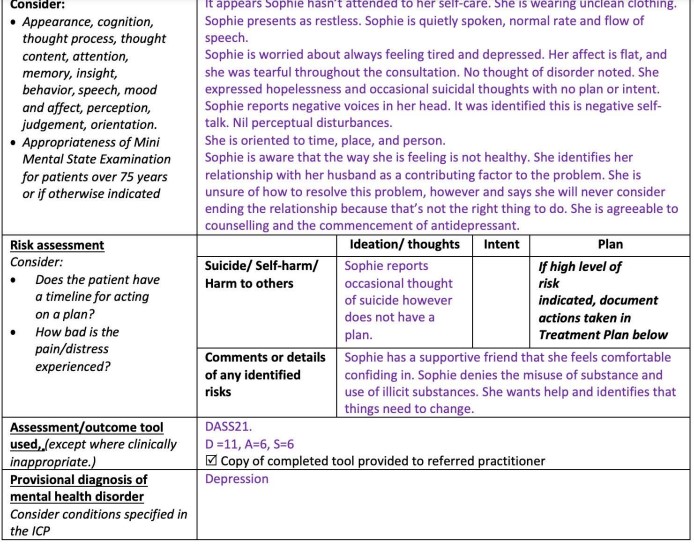
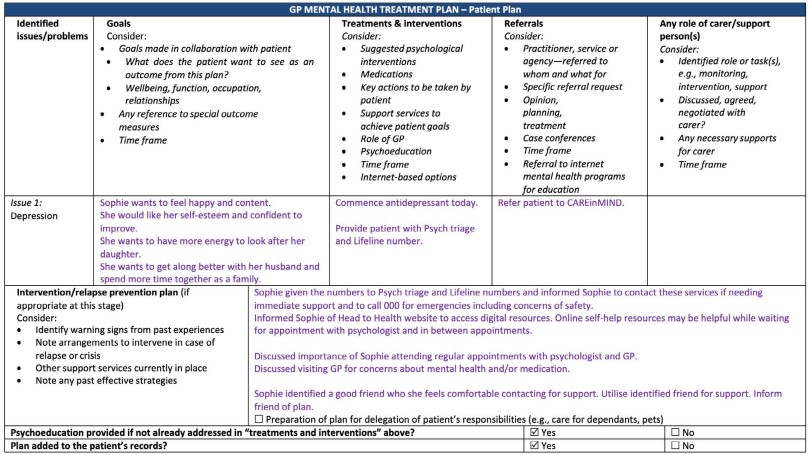
MHTP were previously known as Mental Health Care Plan (MHCP). Here’s an example of a detailed MHTP provided by the RACGP:
© Copyright Everyone Psychology. All Rights Reserved. Do Not Publish or Reprint without Permission. © Everyone Psychology, Online Psychologists Telehealth Counselling and Coaching Australia .
Here are some examples (read a full list here) of eligible diagnoses for a valid MHTP and referral:
- Sleeping problems
- Anxiety
- Depression
- Co-occurring anxiety and depression
- Adjustment disorder
- Grief and loss
- Panic disorder
- Phobias
- Post Traumatic Stress (PTSD)
- Substance use and addiction (including alcoholism)
- Obsessive Compulsive Disorder (OCD)
- Sexual disorder
- Conduct disorder
Eating Disorders (such as anorexia, bulimia and binge eating) are best treated under an EDP, but you can get an MHTP for that too.
© Copyright Everyone Psychology. All Rights Reserved. Do Not Publish or Reprint without Permission. © Everyone Psychology, Online Psychologists Telehealth Counselling and Coaching Australia .
Learn more about referrals or MHTPs from the Australian Government Services Website, the Australian Association of Psychologists, or the Australian Psychological Society
 Everyone Psychology
Leave a comment